Discrimination and hurdles within the immigration process impact Haitians seeking safety

Photo credit: by Jhamesha Janella Milord Ashford
Sebastienne Carine Durand, a single mother of two daughters who recently emigrated in Ottawa from Haiti following gang violence.
Sebastienne Carine Durand had no choice but to leave Haiti with her two young daughters in 2022 because her life was at risk.
“These girls have really been able to adapt to different environments, different circumstances, especially my eldest daughter,” says Durand. “When we had to go to the border to leave, all I told her was that we were going to leave the country. I told her, ‘We’re not coming back’.”
As long as they weren’t separated, her daughters were ready to brave any storm.
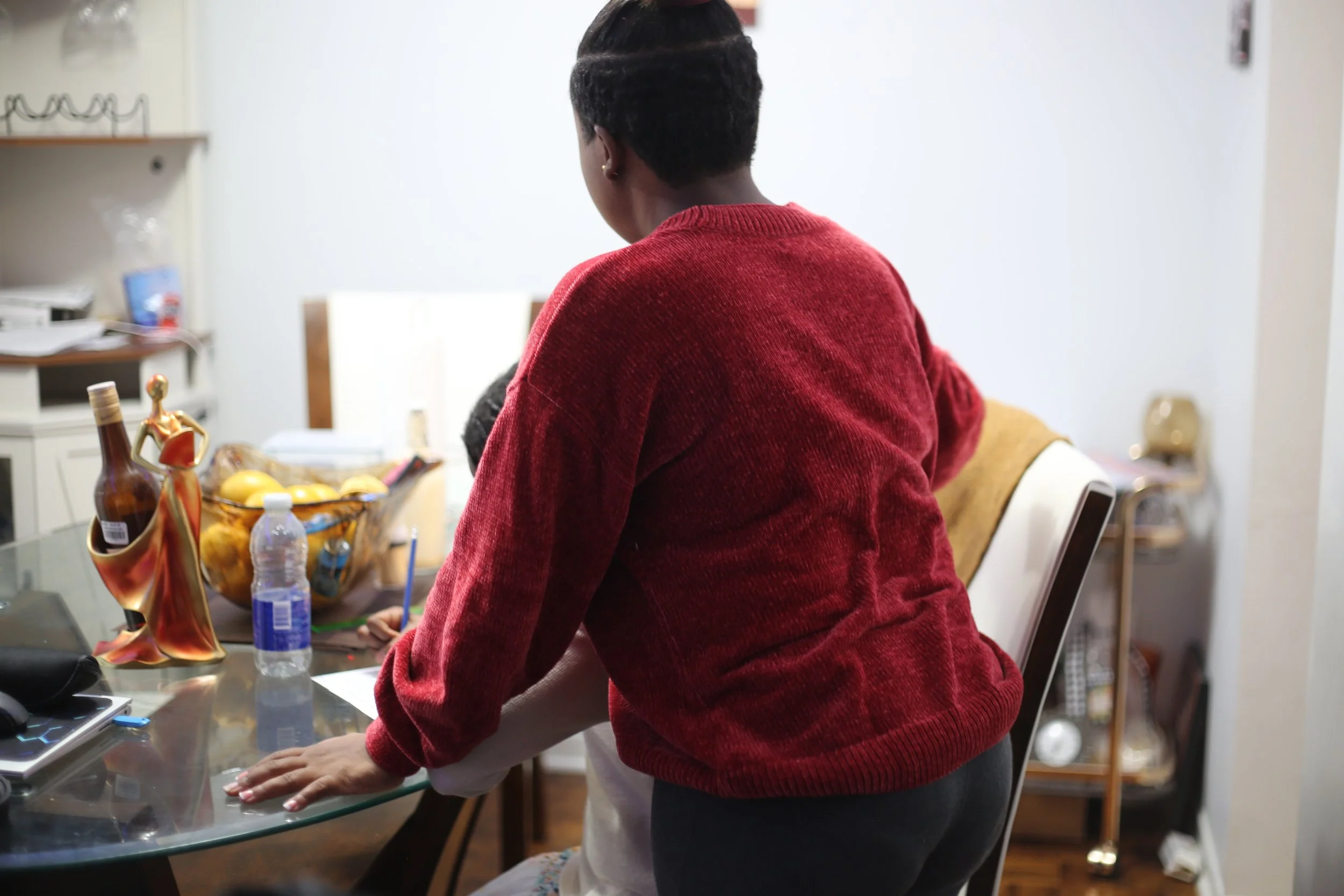
Photo credit: by Jhamesha Janella Milord Ashford
Durand helping her daughter with some homework in their Ottawa home.
The island had undeniably been struggling post-earthquake since 2010, but things got worse when Haïti’s president, Jovenel Moïse, was assassinated on July 7, 2021.
The latest displacement tracking matrix report from the International Organization for Migration shows that, as of October 2025, the number of people displaced by violence and instability in Haiti reached abnormal levels, with over 1.4 million people forced to evacuate their homes this year.
The month of July 2025 marked a noticeable increase in asylum claims after U.S. President Donald Trump’s administration decided to end the Temporary Protected Status.
The Canada Border Services Agency reported a 263 per cent rise in asylum requests at a port of entry in Saint-Bernard-de-Lacolle, just south of Montréal, compared to the same period last year.
After many hardships along the journey of leaving Haiti, Durand was able to get help from an old friend she used to go to school with back home. Communications and community engagement officer at Centre Toussaint L’ouverture de Service et d’Orientation (CETSO), Daphnée Orizier, who now resides in Ottawa, assisted Durand with joy.
“We helped her find a place to rent since the city was helping with rent allocation,” says Orizier. “Once she settled in her one-bedroom apartment, we started the job hunt and she landed a corporate job at the Transport Canada office in January 2024.”
Durand is now residing in the city’s east end and is pursuing her masters in business administration with a major in human resources.
THE START OF HER PROBLEMS
Back in Haiti, Durand lived a comfortable life where she studied secretarial practices. She holds a bachelor in law and worked for the American government as a consular assistant.
Her life took a turn for the worst when all she needed was her car fixed.
“I had to get a new transmission for my car. I paid for the item and labour which was supposed to take 24 hours,” says Durand. “The gentleman mounted the first transmission to the car. The car wasn’t running properly. I went back to see him and said it wasn’t good. The situation then turned sour. He didn’t want to reimburse me, then tried to intimidate me, telling me you don’t know who you’re messing with.”
Durand took matters into her own hands and contacted authorities but then, she started getting followed home which also led to intimidating phone calls.
“It’s a rather corrupt system. There was a matter of conflict of interest and some commissioners didn’t bother passing over the file to someone else,” says Durand.
As she was trying to wash her hands of the situation and clear her name from vehicle ownership records, the same men, who were linked to gangs, began making death threats.
After much thought and many years in hiding, Durand grew tired of her lifestyle.
“I told myself no more battles, then I saw myself folding my life away in two briefcases with my children, leaving a career, my life, my stability and really facing the uncertainty and everything that comes with it,” says Durand.
Durand had an American tourist visa from previously working at the U.S. embassy in Haiti, so as soon as she left Haiti in 2022, she took that chance to go to New York and stay with her parents. This gave her some time to process everything she went through along with preparing herself for what’s to come.
After some time, Durand decided it was time to leave Brooklyn. She arrived in Canada on July 11, 2022 where, at the time, you didn’t need family or relatives to cross the border.
Following a few months of couch hopping, she was able to secure an appointment with social services to secure stable housing for her small family.
“Once I got to the office, they didn’t want to believe that I was homeless or that I needed help. One of the workers told his colleague ‘she looks like a hijacker’ and I’m like ‘No. Who are you to tell me I’m a hijacker, is it because I’m Black?’,” says Durand.
There was also much difficulty for her to find a job in her field of administration once she got to Ottawa. But with much prayer and drive, she conquered.
“It was only when a random recruiter from the office called and told me ‘I looked at your resume. There’s no way that you can’t work with us,’” says Durand. “There are things that I experienced in Canada where no one gave me a briefing on how to manage.”
FROM POLITICAL TURMOIL TO A HUMANITARIAN CRISIS
As Durand settles in Canada, the violence in Haiti continues.
Just recently, Associated Press reported on an incident that took place over the weekend of Nov. 28, 2025, where gangs in Haiti’s central region left hundreds of locals to flee gunfire and burning homes.
Gang leaders cover all entry and exit points inside Port-au-Prince, where local authorities and politicians left the capital with no one left to protect citizens.
As of late June, Trump’s orders put over 300,000 Haitians living in the U.S. at risk of deportation. A federal judge temporarily blocked the order, but legal challenges are ongoing, and the situation remains unclear.
This leaves many Haitians in the U.S. with a feeling of uncertainty and unease. According to CBSA, more than 5,500 asylum seekers have turned to Canada since July, with a significant portion of people coming from the U.S.
LIFE IN HAITI
Menesly Alexandre was born in a coastal commune called Léogane, Haiti in 1989 then moved to La Plaine, the fourth communal section in the Nippes department of Port-au-Prince, Haiti where he currently resides. Alexandre studied social work but is in need of a higher education.
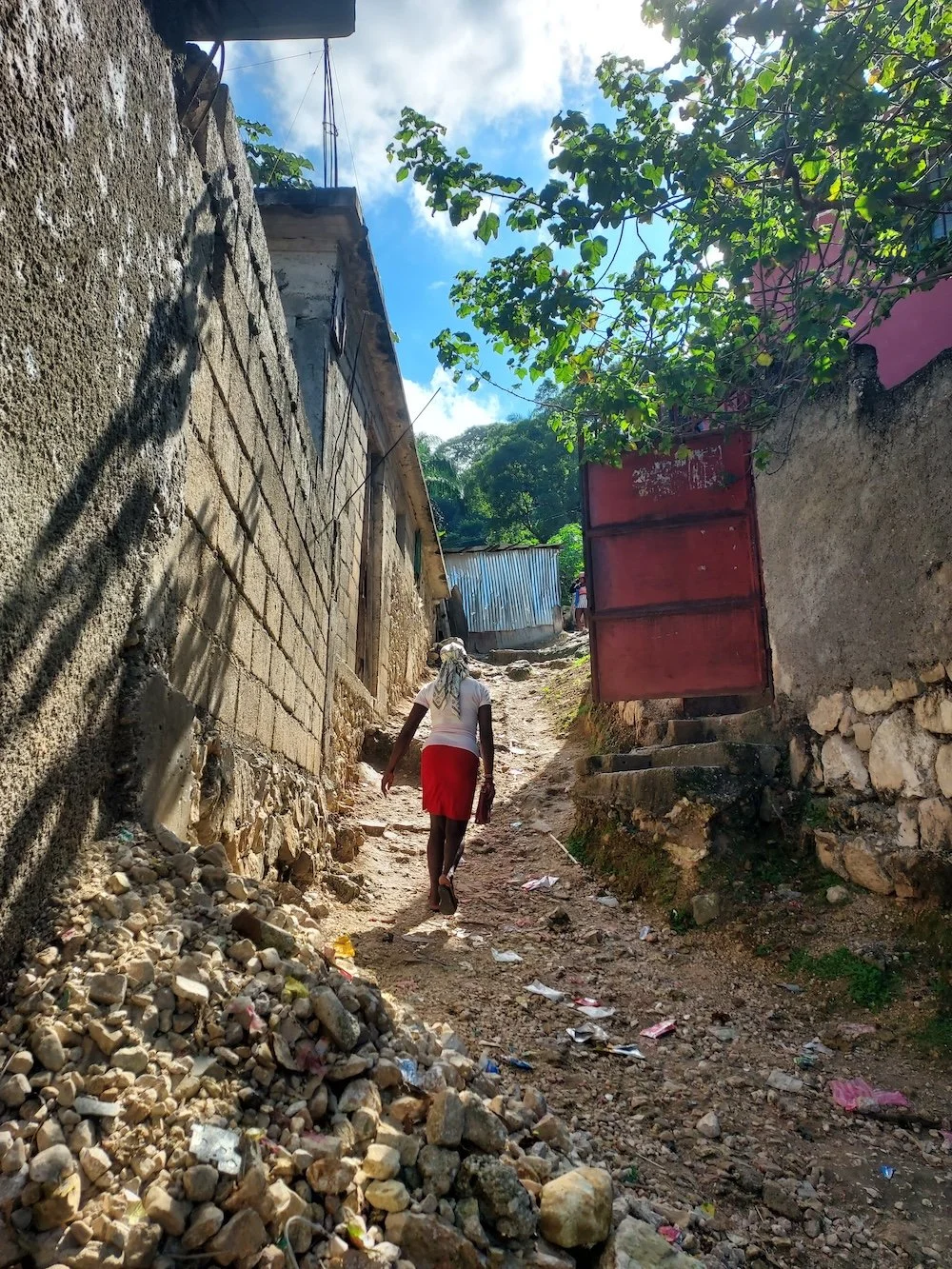
Photo credit: picture provided by Menesly Alexandre.
Neighbourhood in La Plaine, Port-au-Prince. Alexandre tries to display the living conditions in which him and his neighbours are subject to.
“Nowadays, it’s become a little tough to find a good job if we don’t have a master’s degree, although we have a social work license, the positions are really demanding,” says Alexandre. “This is why I would like to get a master’s degree in Canada. It can increase my chances to find a job, and return to my country.”
Canada was Alexandre’s first choice for a new home after much research and his appreciation for its welcoming ambiance, plus many of his friends live in Laval.
He applied recently for a student visa to complete social work studies at Laval University but was denied when he couldn’t prove he had enough money to fund his schooling.
Temporary study permits in Canada are $150, but many other costs are for medical records, police checks and other identification purposes.
In September 2025, the Canadian government also increased the financial proof requirements for international students applying for student visas in order to reflect the higher cost of living in Canada.
Despite Alexandre’s different motivations for leaving the country, he says that the living situation in Haiti is still a major cause for concern. He says he and his two year-old son were attacked on the way home one day.
Guards stop and threaten locals for money all the time, Alexandre says.
“Right now, It’s complete chaos. Today, anarchy dominates the country,” says Alexandre.
As a practising Christian, he says only his faith keeps him hopeful for a brighter future.
THE NEXT GENERATION
Because of the country’s collapse, many people lost jobs and some public servants, especially teachers, had to get out of Haiti which could potentially leave a lot of children with no education.
“Unfortunately, the situation in Haiti is extremely worrying. If it continues like this, we may come to a stage where universities and schools will have to close their doors,” adds Alexandre.
Despite the need for acceptable living conditions, Alexandre believes what needs to be prioritized is the next generation. He says the youth are targets and are being molded into joining gangs.
“There is the social pressure that exerts itself when living as a teenager for all young people,” says Alexandre. “You can be influenced and easily integrated into the armed groups as well. These people give them (the youth) money without difficulty. Young girls have relationships with whom they would never have a relationship with.”
Priscilla Zelaya and Bertrhude Albert, two alumnae of the University of Florida, co-founded “P4H” (formerly known as Projects for Haiti), an organization who offers training programs for educators in Haiti with over 16,000 teachers trained.
P4H is currently running a fundraiser with a goal of $50,000 to bring quality education to another 35,000 students in 2026.
Durand is currently awaiting her permanent residency card and Alexandre says he will not stop fighting for his study permit.
Undefeated by all difficulties put against them, both Alexandre and Durand are looking to help the next person facing similar barriers and are hoping others can do the same.
“The first thing I want people to do is not to stigmatize us,” says Durand. “I say this because, not everyone comes to Canada with the idea of lying or taking advantage of the system.”
